


June 30, 2026 - National Retail Group
Shop for Lease vs Shop for Sale: Which Is Better for Your Business?
Category : Leasing Tips Retail
Share:


Latest News
-
Commercial Property Leasing Trends Shaping Australia’s Retail Market
May 7, 2026 - National Retail Group -
Long-Term vs Short-Term Leases: Which Is Better for Your Medical or Retail Business?
April 29, 2026 - National Retail Group -
Medical Clinic and Rooms for Lease: What You Really Need to Know Before Signing
April 23, 2026 - National Retail Group -
What Tenants Ask Most: Top FAQs in Melbourne Commercial Leasing
March 26, 2026 - National Retail Group -
Retail Shop Leasing Mistakes First-Time Business Owners Make
February 17, 2026 - National Retail Group -
Commercial Real Estate for Lease: Retail vs Office vs Industrial Spaces
February 6, 2026 - National Retail Group -
What Tenants Ask Most: Top FAQs in Melbourne Commercial Leasing
December 9, 2025 - National Retail Group -
South Melbourne’s rare island property sold
November 25, 2025 - National Retail Group -
National Retail Group secures rare South Melbourne island site off-market & below replacement cost
- National Retail Group -
Nigel Satterley Targets $1B Commercial Pipeline: What It Means for Retail & Medical Assets
November 18, 2025 - National Retail Group -
Chemist Warehouse Founders’ $5b Property Push: Retail & Medical Outlook
October 30, 2025 - National Retail Group -
Brisbane CBD Office Market: $19m Acquisition Signals Investor Confidence
- National Retail Group -
Landmark building in Adelaide’s Rundle Mall sold to National Retail Group
October 23, 2025 - National Retail Group -
$150m Rathdowne town centre set for build-start anchored by Coles supermarket
- National Retail Group -
Office Space Leasing Terms Explained: What You Need to Know
September 2, 2025 - National Retail Group -
How a Commercial Buyer Advocate Can Improve Your Investment Portfolio
August 19, 2025 - National Retail Group -
How Asset Management Maximizes Wealth for Private Families
July 31, 2025 - National Retail Group -
Your Guide to Commercial Property Leases
July 9, 2025 - National Retail Group -
Exploring Leasing of Retail Space in Melbourne
May 2, 2025 - National Retail Group -
Securing High-Quality Tenants: Proven Strategies for the Commercial Landlords in Melbourne
April 17, 2025 - National Retail Group -
The Future of Office Space for Lease Melbourne: Trends and Insights
March 19, 2025 - National Retail Group -
25 Lease Terms Every Medical and Retail Tenant Should Know
November 25, 2024 - National Retail Group -
Avoiding Common Landlord Pitfalls with Expert Asset Management
July 18, 2024 - National Retail Group -
Importance of Professional Asset Management: Maximising Your Rental Income
May 29, 2024 - National Retail Group -
The Role of An Asset Manager: What Landlords Should Expect
May 23, 2024 - National Retail Group -
Why Every Landlord Needs a Skilled Asset Manager: Key Benefits Unveiled
May 13, 2024 - National Retail Group -
How to Choose the Right Asset Manager: A Guide for Australian Landlords
May 2, 2024 - National Retail Group -
Aussie mall named one of world’s most expensive shopping strips
January 9, 2024 - National Retail Group -
Commercial Property Renting Checklist 2026
January 1, 2024 - National Retail Group -
Tips for Finding the Perfect Shop for Lease for Your Business
December 7, 2023 - National Retail Group -
The Impact of Location on Your Office Space Rental Decision
November 28, 2023 - National Retail Group -
Bunnings hardware sites hit the market
November 22, 2023 - National Retail Group -
Valmorbida family sell ex-GJ Coles store to Chemist Warehouse executives
November 21, 2023 - National Retail Group -
Opening auction bid leaves other buyers in dust
November 20, 2023 - National Retail Group -
New and improved shopping experience
September 20, 2023 - National Retail Group -
Epsom Village shopping centre overhaul will include big names
July 25, 2023 - National Retail Group -
Crowdfunding aims to raise $3 million towards buying the Tote
March 11, 2023 - National Retail Group -
Former Dimmeys Arcade in Townsville’s CBD to be revitalised after 15 years
March 8, 2023 - National Retail Group -
Country department store sold to Chemist Warehouse interests
February 10, 2023 - National Retail Group -
Amendment to Epsom village plan paves way for intersection upgrade
January 27, 2022 - National Retail Group -
Leasing Commercial Property for Small Business – 4 Factors to Consider
July 17, 2021 - National Retail Group -
FOR LEASE | INNER CITY HQ | PRESTON | STAND ALONE TWO LEVEL BUILDING
July 8, 2021 - National Retail Group -
AWH confirms location of upcoming COVID-19 vaccination clinic in Wodonga
June 2, 2021 - National Retail Group -
The mega makeover coming for the city
May 27, 2021 - National Retail Group -
The Commons – An exciting new retail precinct in the heart of Townsville
April 30, 2021 - National Retail Group -
Professional Office For Lease In Werribee Now Available
March 16, 2021 - National Retail Group -
11 Things to Consider Before Leasing Commercial Property
February 22, 2021 - National Retail Group -
Ten Questions To Ask Before You Sign Commercial Property Lease
January 23, 2021 - National Retail Group -
Landlords are not the enemy
April 2, 2020 - National Retail Group -
5 reasons to Lease next to Chemist Warehouse and create powerhouse traffic generation for your business!
March 16, 2020 - National Retail Group
Categories

Choosing between leasing and buying a shop shapes your cash flow, flexibility and long-term wealth. While leasing preserves your capital for other investments, buying property offers equity and total operational stability. This guide explains the financial realities of buying and leasing.
Every new or established retailer, cafe owner or service business eventually faces the same dilemma: whether to buy a new property or to rent a space. Choosing a commercial shop for rent near a growing residential area with major foot traffic will entirely shape your cash flow, flexibility, and your long-term wealth.
To be honest, there is no correct choice. A new café might thrive in a leased space with low upfront costs, while an established business with strong, predictable revenue might be better served by owning its premises outright. In this guide, we break down the pros and cons of each path so you can make a decision that actually fits your business, not just your budget.
Pros and Cons of Leasing a Retail Shop
Leasing is a highly common choice for new businesses. In general, renting a retail shop requires a lot less of an initial capital investment than buying, so you can have more money in the business and less money tied up in a substantial capital investment.
Advantages of leasing are:
- Lower entry cost – Rather than needing a large property deposit and commercial loan, you typically only need a bank guarantee or security deposit (usually 3-6 months rent) plus your first month’s rent upfront. This ultimately frees up vital cash flow to buy stock or hire staff.
- Flexibility at lease end – A lease ties you down for a specific term (e.g., 3 or 5 years). Still, it allows you to move or upsize to a bigger space when your term is up, without the headache of trying to sell a commercial building.
- Regulatory cost protections – In Australia, retail tenants are protected by state-specific Retail Leases Acts. This means landlords are generally prohibited from passing on structural repair costs or land tax to a retail tenant in most Australian states. In contrast, a property owner must pay every cent out of pocket.
- Easier access to prime locations – A well-positioned shop front for lease in a high-traffic strip or shopping centre is often more attainable than buying in the same location, where purchase prices can be well out of reach for a smaller operator.
Disadvantages of leasing:
- Rent reviews can increase the property cost over time.
- You don’t build any equity in the property.
- Security of tenure depends on your landlord renewing the lease on terms you can live with.
Benefits of Buying a Commercial Shop Property
Buying a property means investing in an asset, and it has many benefits such as:
- Capital growth – A well-located retail property value grows over time.
- Long-term stability and control – You are completely immune to landlord decisions, sudden lease terminations, or erratic rent hikes. While structural changes or a change in business use will still require local council development approval (DA), you never have to ask a landlord for permission to modify your space.
- Fixed expenses – A fixed-rate loan can help simplify long-term planning.
- A second income stream – If you are willing to relocate, you can lease out the property to create a second income stream.
Buying properties suits businesses that are confident in the location for long-term growth. But the big downside is that you’re stuck with a huge capital investment and lose flexibility.
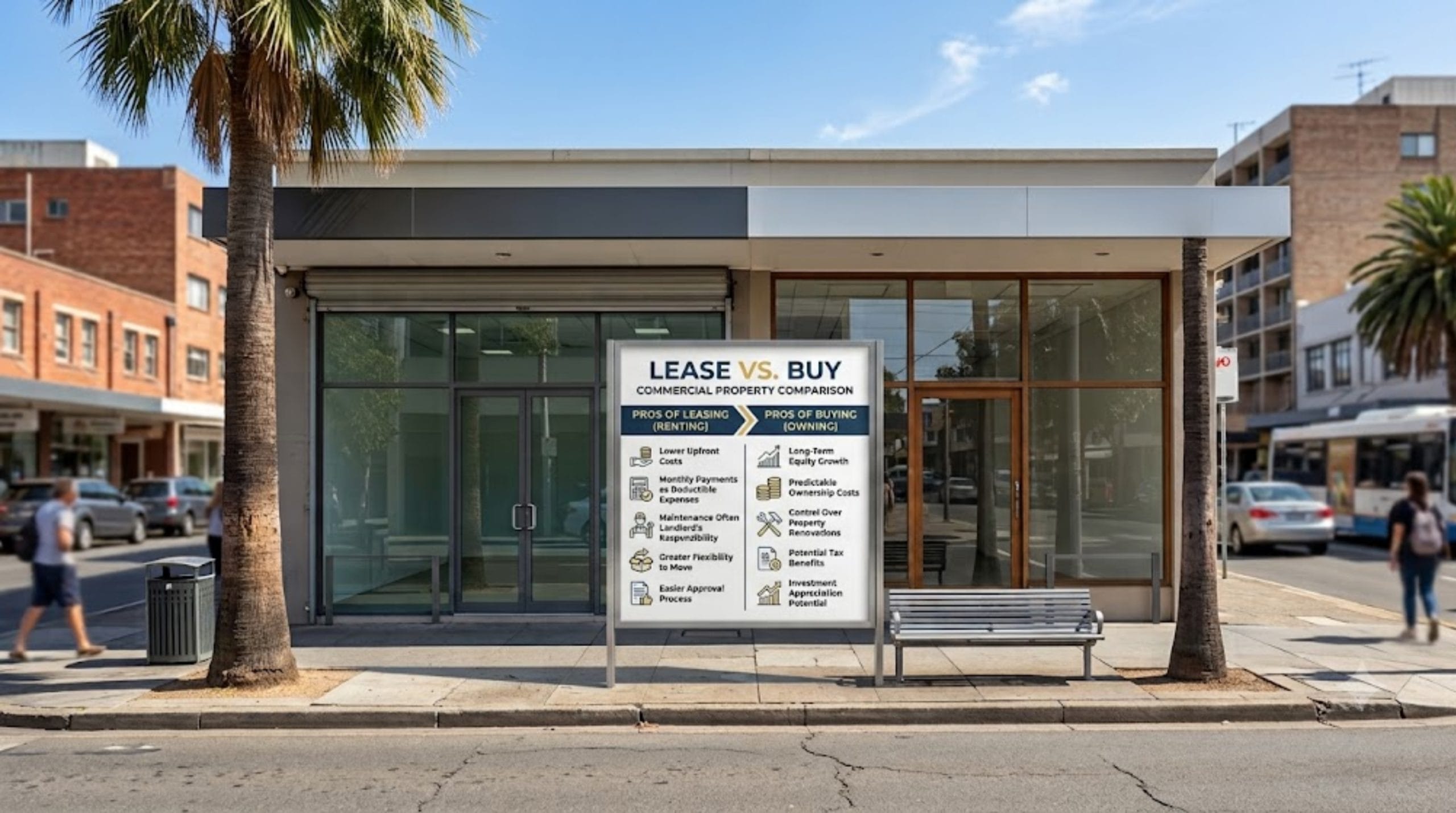
Lease vs Buy Comparison
| Financial & Operational Factors | Leasing a Space | Buying a Property |
|---|---|---|
| Preliminary Capital Required | Lower (Security deposit/bank guarantee + advance rent) | High (20%–35% deposit + stamp duty & loan costs) |
| Monthly Recurring Expenses | Fixed rent + agreed outgoings | Mortgage repayments + full council rates, insurance & maintenance |
| Value of Long-Term Assets | None (Capital is liquid for business operations) | High (Adds to property equity and capital growth potential) |
| Flexibility of Operations | High flexibility to move or downsize at the end of the lease | Less flexible; to exit, must sell or find a tenant |
| Control Over the Space | Subject to landlord approval and make-good provisions | High control but structural changes still require council DAs |
Risks of Leasing a Business Shop Location
While leasing keeps your initial capital requirements low, it introduces operational risks that require careful management.
- Occupancy costs that exceed the budget.
- No renewable guarantee.
- The landlord can redevelop and resell the place at the end of the term, forcing a business to relocate.
- Limited control over structural changes.
This is not to say that taking a lease on a shop is a bad thing; many businesses will lease for the entire life cycle of their business – but it does mean that the terms of the lease and renewal options need to be looked at carefully before signing. Reading the fine print on rent reviews and make-good obligations up front can save a lot of stress down the track.
Making the Right Call for Your Business
Leasing is beneficial for new shops that are still getting a solid footing in the market. But if you have an established organisation with consistent revenue, then you can consider buying the property.
We at NRG Property help retailers and business owners across Australia find the right premises for where their business is today and where it’s heading. Whether you are looking to lease or purchase a shop, our team can help you make a confident, well-informed decision.
FAQs
Is it better for a small business to lease or buy a shop?
Lease or buy is a decision you’ll have to make depending on where you are in your business. If you’re new to the industry, you should lease because it costs less capital to get started and it gives you the flexibility to move. Companies buying a shop are looking for long-term stability and growth, which means they have very predictable revenues.
What are the advantages of leasing a shop?
Leasing properties will also reduce your initial capital spend as they require security deposits rather than a hefty property investment. In Australia, tenants are also protected by law from unexpected structural repair costs or land taxes, meaning their ongoing operating costs are very predictable.
What are the advantages of buying a shop property?
Buying a shop property gives you long-term wealth through property equity and capital growth. It eliminates the risk of sudden rent hikes, and you can renovate your property without the landlord’s permission; if you want to relocate, you can rent it out and create a second source of income.
How does leasing a shop affect cash flow?
Leasing provides essential working capital. Avoiding a hefty 20% to 35% property deposit means you keep your cash reserves more liquid. You can put this freed-up cash flow right back to work in revenue-generating areas of your small business, such as purchasing inventory, upgrading equipment or hiring staff.
What Are the Risks of Leasing a Commercial Space?
Leasing can leave your business open to compounding rent reviews, zero equity and tenure insecurity. If your landlord chooses to redevelop the property, refuse a lease renewal or increase your rent to an exorbitant level at the end of your term, you’re looking at an incredibly expensive and disruptive move.
What are the potential risks of buying a shop?
Buying ties up a lot of capital that could otherwise be used to grow your business, reducing your overall liquidity. You are responsible for the cost of all structural maintenance, council rates and insurance. Plus, if the local market turns or your business shrinks, it takes time to sell a commercial property.
Does owning a shop provide better long-term value?
Suppose your location stays strong, yes. Ownership converts a monthly operating expense into an asset that builds wealth. Instead of making payments on a landlord’s mortgage, your monthly payments build equity in the property. You also enjoy the direct benefits of long-term capital appreciation and absolute operational security on your storefront.
- RETURN TO NEWS
-
Commercial Property Leasing Trends Shaping Australia’s Retail Market
Next
